Monday, October 19, 2015

The PLCB has nothing to hide...unless it makes them look bad

Chairman Tim Holden:
What's the PLCB hiding?
As reported Sunday in the Pittsburgh Tribune-Review the PLCB, an agency with no business reason to hide anything (since they have no competitors), has not been very open or honest when dealing with their bosses — that us, the citizens of Pennsylvania. After all, that's what their supporters keep telling us, that we're the owners of a "valuable public asset." Shouldn't the "owners" be able to ask questions and get answers?

That's not what happened, according to the Trib's reporter, Kari Andren; instead, the LCB instructed their press secretary to delay the release of such information by forcing the Trib to go through Right To Know channels:
The agency's board members directed a press secretary not to provide basic information about a former employee, such as dates of service, job title and salary, unless the reporter filed a formal request — a move that could have delayed the release by more than a month, the emails obtained under the state's Right to Know law show.

We have to watch what we ‘give' her regarding employees without going through the Right to Know channels, even if it is public information,” board member Michael Negra wrote in a Sept. 23 email. “Agree,” Chairman Tim Holden responded the same day.
LCB spokesperson Elizabeth Brassell said the agency, “fully respects and supports the release of public information to interested parties.” But Erik Arneson, head of the agency charged with overseeing the state's open records act, said the board members' actions were not in keeping with the intent of the law. “The Right to Know (RTK) Law was not designed to be a tool used by agencies to delay access to clearly public information,” Arneson said.

More proof of this use of delaying tactics is the now 111 days over which the PLCB has refused to release their yearly financial statements. Some were verbally stated during the Ross hearings over two months ago, but so far nothing has shown up on paper or online. If the PLCB were a "real" business, they would have had to release their yearly statement before the first quarter earnings statement. However, the PLCB doesn't update the citizens with quarterly statements. Why not? It's a painfully simple answer: they aren't a real business, and never have been, and never will be.

Melissa Melewsky, a media lawyer with the Pennsylvania NewsMedia Association, agreed that the LCB's approach doesn't follow the spirit of the open records law, or Gov. Tom Wolf's call for government transparency. Wolf said he was “confident in Chairman Holden's ability to continue to make the LCB more transparent,” and the previous Chairman (and still current board member) Skip Brion has said, “This is a state agency; we should be as transparent as possible.” Apparently he has changed his mind.

This is not the first time the board has used RTK to delay, or has done things in the dark that should have been in the sunshine of public scrutiny. Years of notational votes (where the Board members meet informally and off the record to make decisions, and then only vote on 'that thing we talked about' in official meetings) and vague to non-existent board meeting information have keep the "owners" (you and I) in the dark about the working of the PLCB.

Who knows, if the public were privy to the machinations of the State Store System, we may never have had wine kiosks, or $66 million in computer system cost overruns, or paid over $4 million for an out-of-state firm to come up with that snappy "Fine Wine And Good Spirits" branding. All money well spent, I'm sure...once the real facts finally come out in a few years, the brilliance of it all will shine clear. Or not.

This is not the first time the PLCB has been publicly charged with ignoring the intent of state law; this is not the first time they've lied by omission. This is not the first time they've delayed the release of reports on their performance. So we have to ask: why the delay this time? We see the smoke, what is the fire that the PLCB is trying to hide while privatization is still a very real possibility in the Legislature? We urge the Trib to keep digging — faster, if possible — and encourage the reporters at the Inquirer, PennLive, the Daily Record, and the Post-Gazette to do the same. Because we the citizens — the owners — need this story to come out before privatization slips away. It's clear that the PLCB feels threatened by it; that's enough reason to dig out the truth.

The time to privatize is now.

Tuesday, October 13, 2015

NEWS FLASH! PLCB Supports PA Wine Month

PR NEWSWIRE
Dateline Harrisburg: October 13, 2015

The PLCB announced today that as long as the threat of privatization continues they will support Pennsylvania wine makers. Chairman Tim Holden stated that the the PLCB is fully behind Pennsylvania wine makers, and the proof is the 50% increase in shelf space allotted to Pennsylvania wines.

"The change from two to three shelves of Pennsylvana wines is a big step for the state's vintners," Holden announced. "We support all Pennsylvania wineries, even the ones that can't afford to sell to us because of our pricing policy (a majority of the over 200 wineries in the Commonwealth). In the past 5 years we have instituted ONE new policy to help Pennsylvania wineries, an increase of 100% over the previous 75 years, to try and make up for selling bulk California wine that undercut the state's own producers. We won't get caught doing that again."

Board member Michael Negra chimed in with this bit of techno-hope: "Over the next five years we plan to attempt to put a tab on our website so you can see all the Pennsylvania wines available for order. Someday we hope to be able to allow a customer in Erie to order a Lehigh Valley wine and have it delivered to their local store! But for the moment we aren't equipped to ship and warehouse the hundreds of different SKUs that would require, and of course we couldn't allow the winery to ship direct to the customer; that would mean a loss of control. And 'Control' is our middle name, kind of." 


Consumer reaction has been mixed since the change in the stores.  "I don't know where to find the Riunite now." said a State Store customer, "It was always under the PA wine section before and now they have moved it. because of the extra shelf of PA wines."

"I think it is great!" said another consumer as he walked past the Pennsylvania wine section to get a box of Franzia. "I think the state should support in-state businesses. Maybe not having the PA wine section in the back corner of the store would be better...but hey, I'm sure they know what they're doing."

Friday, October 9, 2015

Three months and no financials?

It's over three months after their fiscal year ended, and the PLCB has still not managed to figure out how to report their financials. By comparison, the Department Of Revenue, an agency more than ten times the size with millions of accounts has somehow managed to get an unaudited year end totals  out which is all we are asking for. And they did it the day after the fiscal year ended!

I think I know what the problem might be and offer this suggestion.

BRIBES are an expense.

However, KICKBACKS are an asset.

There. That should help speed things along. No charge for the service.

Monday, October 5, 2015

The PLCB enters the lottery business

Well, it is getting to be that time of year when the PLCB decides what the "most fair" way is to divvy up limited bottles. Last year it was Stacy Kriedeman saying that selling the products online is the most fair method. This year we get Board Chairman Tim Holden presenting a new "most fair," saying "In order to ensure that all consumers interested in a particular high-demand product have a fair chance to purchase the product, we have developed a lottery system for our most limited products.” 

Doesn't that mean people haven't had a fair chance in the past? Maybe it just means that the contractor they hired to do this gets to be the fall guy if it tanks. and then PLCB can claim it wasn't their fault. Just like the Oracle roll out disaster; they don't have the expertise to do it in-house without screwing it up. (I wrote about what I thought the system should look like at the end of last July. They didn't take all my advice so we'll see what happens.)

But is this new most fair method...even fair at all? There are the questions of legality about selling only to a PA resident. The state already restrains trade for their own citizens -- the police-enforced monopoly prohibits us from buying booze anywhere but in Pennsylvania -- but can they restrain trade to non-Pennsylvania citizens? Does or does it not violate Federal statute and will somebody invest enough to find out?  Can they have two systems, in which they allow non-residents to buy alcohol on their website, but refuse to sell these limited items to them at the same time?  What about the military personnel who can maintain the state as their residence but obviously don't have all their bills sent here. State-sponsored discrimination of the very people who are defending the state and country? How cool is that, PLCB?

The only way you will get this set in PA
 is if you copy this picture

Then there are people who own property and pay taxes to PA but don't live here. Is this another benefit of paying your taxes to support a government agency that couldn't care less about you? (I don't want to hear that crap about no tax dollars are used to run the PLCB. As long as the taxpayers are on the hook for over $600 million in pension and medical debt, as long as we have no choice on where to buy our booze, ALL PLCB money is taxpayer money.)

So on the 13th we get to see the first shakedown of the new system, when 24 bottles of some Buffalo Trace Experimental bottles are offered in two lotteries of 12 each (25% of which — 3 bottles of each! — is reserved for a separate licensee lottery). I'm sure the demand level will be close to what the Antique Collection or Pappy frenzy is and will be a real test of their system.

Of course, don't expect to get a flight of the full set of Pappy releases, or a complete BTAC collection. That's impossible in the "most fair" world of the PLCB. 

Sunday, October 4, 2015

The difference between the PLCB and freedom

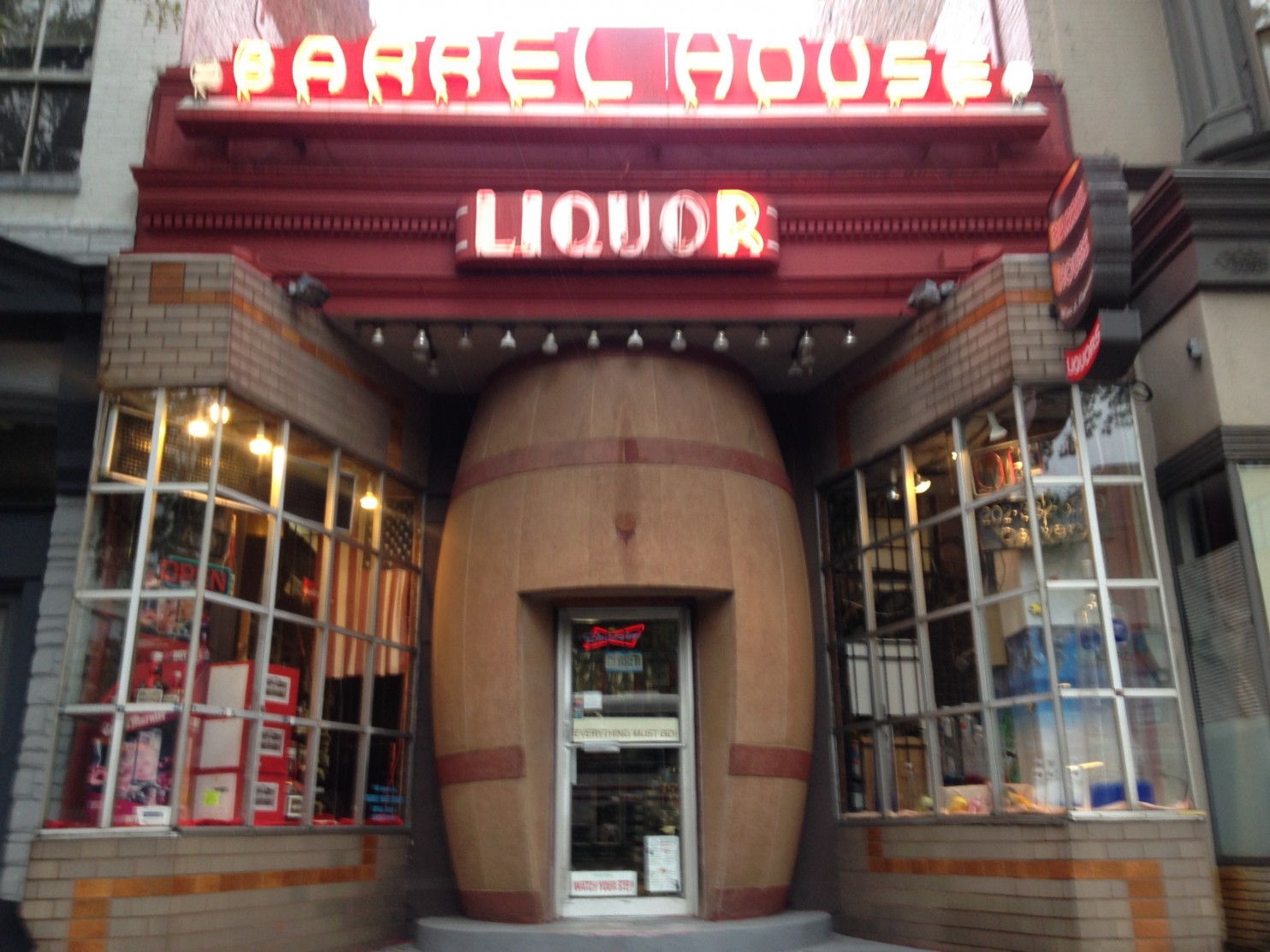
Pennsylvania State Store 1945, an historic mistake


Barrel House Liquors built 1945, possibly an historic landmark


Monday, September 28, 2015

Who can answer this?

As reported by numerous papers...

If, as Governor Wolf is suddenly proposing, leasing the State Store System to a private management firm "is a way to make the liquor stores more profitable and provide better service to consumers"...can the Governor answer the following seemingly obvious questions about this latest example of Wolfonomics?

Wouldn't a fully private system provide even better service to consumers?

Wouldn't a private system that puts wine and liquor INTO grocery stores -- on the shelves -- be even better than a system that puts it somewhere in the vicinity of grocery stores?

Wouldn't a private system that allows for different levels of service -- small neighborhood stores, wine or whiskey specialty stores, huge discount mega-stores -- be even better than only one that provides only one level of service, for every store, in the entire state? (Keep in mind: it would still be illegal to go across the border.)

Wouldn't a private system that stocks more items than the entire State Store System stocks (and actually has them, instead of just listing them online) now be even better for consumers?

Wouldn't a private system that at least triples employment (as shown by the experience in Washington State and Alberta, which both fully privatized their monopoly systems) be even better for the state and the citizens that are employed than a system that limits employment and doesn't allow any small businesses?

Wouldn't a private system that triples or quadruples convenience (as measured by number of stores) be even better for the consumer than one that will still limit convenience to fewer stores than there were 40 years ago?


Wouldn't a private system where many suppliers try to bring their product to market be even better than one person or department selecting for the entire state? (In case you missed it, this is what happens when one person has that police-enforced monopoly power.)

Wouldn't a private system be even more responsive to consumers needs and wants, since the individual stores would have to compete for your business, rather than you still having no other choice than the monopoly State Store System...whatever the new name they slap on it is?

Wouldn't life just be far better if Pennsylvania had a normal liquor retail market without the state being involved in retail and wholesale at all?

You bet it would.

Tuesday, September 22, 2015

Could Border Bleed Actually be $500 million?

Everybody thinks that border bleed — Pennsylvanians going "out of control" to buy booze in other states, spurning the State Store System...which is illegal — only happens on the southeastern border of the state*, when in reality it occurs across all of Pennsylvania's borders and for a number of reasons.

Why do Pennsylvanians break the law just to buy booze? Why, for everything from spur of the moment decisions to deliberate shopping for lower prices, more convenience, different products not carried by the state stores, or just plain better service that a non-monopoly store can only provide. A private store depends on pleasing their customers; a monopoly store knows you have nowhere else you can legally go.
Back in 2004 a study prepared for the Pennsylvania Food Merchants Association (long-time foes of the state liquor monopoly for perfectly self-interested reasons: they'd like to sell wine and spirits themselves, like stores in other states) determined that 29.4 percent of the Commonwealth's consumption of wine comes from cross-border sales, as well as 20.8 percent of distilled spirits. Has much changed since then?

Let's extrapolate, shall we? In 2004, there were about 640 state stores. Now we have 605, so convenience certainly didn't increase. 29.4% of wine sales would have been $248,460,768.80 in 2014 (Can't use current numbers, because over 11 weeks after the end of the fiscal year the PLCB still hasn't released them). 20.8% of spirits would result in $243,569,926.08, for a grand total of  $492,030,694.88.  Not quite $500 million, but then I'm using numbers from two years ago. I'll bet it would be over the threshold if the PLCB ever decides to let us know how they did last year.

In 2010, a study that was made by the Wine and Spirits Wholesalers of America, they found that 23.6% of wine sales were done out of state or just over $200 million for wine alone. Using the current ratio of wine to spirit spending that would mean $276 million spent for spirits or a total of $476 million in total border bleed (within 3.25% of the extrapolated 2004 numbers). Close enough for PLCB work, as they say.

The PLCB Neiman report of 2011 had it over $230 million and that was for just 8 of 67 counties and didn't sample any Maryland sales at all. As I pointed out in my report in February, that number is certainly well above $300 million now. Do the other 59 counties spend $150 million out of state? I can't prove it using just the Neiman report, but the other studies indicate they probably do.

Has anything changed since 2010-11? Is the economy more like 2004, or even better now?  Have gas prices come down somewhat? Do people travel more? Of course, the answer to all those questions is yes. The Neiman report showed that even during the recession people that shopped both PA and out of state stores spent more money out of state than in state in those counties and at almost all levels, but especially higher levels, than they spent at state stores. And they did it for the same reasons they always did:

Travel out of state for a broader selection and better price (Neiman report pg 28)

Go out of state to get better prices and stock up on personal supply (Neiman report pg 36)

Recapturing some of that $500 million potential through privatization means more jobs, more taxes collected, more businesses, more selection, more choice, and more benefit for the citizens by not having government interfere with retail. Painting your PA liquor jail cell and extending visiting hours (or selling the jail to some outside firm, Gov. Wolf's latest dim idea) might be better than what you have now but it isn't the same as being a customer in a free market.

Don't "modernize" it or lease it, and don't leave it as it is: NORMALIZE IT. 


*This is probably because Philadelphia-area citizens are so blatant about it; we just don't care at all.