Showing posts with label Breaking The Monopoly. Show all posts

Friday, August 9, 2019

What could Tennessee Wine and Spirits Retailers Association v. Thomas mean to Pennsylvania?

I am not a lawyer, and some or all of my thoughts could be right or wrong, so maybe this post should be filed under wishful thinking, but...there seems to be a crack in the control wall. It's from the hammer blow struck by the Supreme Court's decision in Tennessee Wine and Spirits Retailers Association v. Thomas, handed down on June 26. Take a look with me and see what you think. 

The future of the PLCB?

The facts of the case:
To sell liquor in Tennessee, you need a license from the Tennessee Alcoholic Beverage Commission (TABC). That's pretty normal...in states where private liquor stores are allowed. But there was a catch in Tennessee. Under Tennessee Code, to get a license, you must have been a resident of the state for two years. There was a ten year residency required to renew a license, so don't plan on leaving. And yes, the same requirements were there for corporations.

The case stems from two license applications that did not meet the residency requirement. The TABC was planning to approve their applications anyway...until the Tennessee Wine and Spirits Retailers Association informed TABC that if they did, they planned to sue. (You know...to protect their competitive advantage.) The TABC preemptively went to court to determine the constitutionality of the requirement. The district court ruled that it violated the dormant Commerce Clause of the U.S. Constitution (Been saying that about the PLCB for years! -- Lew). The Sixth Circuit affirmed, and it was off to the Supremes, because the Association wasn't giving up on their anti-competitive lawsuit. 

Cracking the wall around the 21st Amendment
The Supremes Say: 

In a 7-2 decision (Justices Gorsuch and Thomas dissenting), the court found that: Under the dormant Commerce Clause, notwithstanding the Twenty-First Amendment, a state may not regulate liquor sales by granting licenses only to individuals or entities that have met state residency requirements.

The 21st Amendment has long been held to allow states free rein on writing laws controlling the sale of alcohol within their borders. Section 2 of the Twenty-First Amendment states: “The transportation or importation into any State, Territory, or possession of the United States for delivery or use therein of intoxicating liquors, in violation of the laws thereof, is hereby prohibited.”

But a number of Supreme Court decisions since the 1990s -- 44 Liquormart, Granholm, etc. -- have been chipping away at the absolute nature of such control. Tennessee Wine and Spirits takes that quite a step further. The Court’s Commerce Clause jurisprudence holds that “a state law that discriminates against out-of-state goods or nonresident economic actors can be sustained only on a showing that it is narrowly tailored to ‘advance a legitimate local purpose.’” Tennessee’s residency requirement clearly favors residents over nonresidents, hard to justify as a "legitimate local purpose" in the face of the Commerce Clause.

That's just what the Supreme Court found. The Court noted that at the time the Eighteenth Amendment (nationwide prohibition) was ratified, it had already been established that the Commerce Clause prevented states from discriminating against the citizens and products of other states. Against this backdrop, when the Twenty-First Amendment was ratified, “the Commerce Clause did not permit the States to impose protectionist measures clothed as police-power regulations.” Thus, while § 2 of the Amendment gives states latitude with respect to the regulation of alcohol, it does not allow them to violate the nondiscrimination principle.

(A discrimination, maybe, against every citizen and entity who would like to sell alcohol in competition with the state's police-enforced monopoly?)

The Court concluded that protectionism is not a legitimate local purpose and that the residency requirement “has at best a highly attenuated relationship to public health or safety.”

My Opinion
Our state law does discriminate against out-of-state citizens and out-of-state economic actors. It also imposes police powers to maintain and enforce protectionist measures. Read the beginning of the Liquor Code Section 104(a):"This act shall be deemed an exercise of the police power of the Commonwealth for the protection of the public welfare, health, peace and morals of the people of the Commonwealth and to prohibit forever the open saloon, and all of the provisions of this act shall be liberally construed for the accomplishment of this purpose."

In the above decision, the Supreme Court held that "Protectionism is not a legitimate local purpose" and stresses the REGULATORY authority, not monopoly authority of the state. But does that make Pennsylvania's Almighty Liquor Code invalid? That just might be the next question the Court will have to decide. How much does the 21st Amendment give the states the right to impose protectionist, monopoly, discriminatory measures, instead of regulation that allows the intent of the Commerce Clause? How much does it matter if the state allows private retailers or only state store sales?

As I said, I'm not a lawyer. But it does make me think of what might be coming down the road at some point. I think that Costco and Total Wine teaming up will have the resources to get it done and none too soon for me.

Privatize.

Sunday, January 4, 2015

The PLCB - Not taking care of the citizens again

The one liquor store in Waynesboro closed on September 13. On August 20th the PLCB was told by the lessor that the lease -- which ended on September 30th -- would not be renewed. It apparently takes the state store system seventeen days to move the equivalent contents of a largish 4,000 sq.ft. house; yet another thing they don't seem to be very good at.

That means there are four State Stores that remain open in Franklin County, which has a population of 152,000. This closing has the residents of Waynesboro driving 8 miles to Greencastle to the nearest State Store (or 15 miles to Chambersburg, a city of 20,000, which has two State Stores!) or having the choice of over fifteen different liquor stores in Hagerstown, MD, a town of 40,000...only 12 miles away. How big does a town have to be to have more than fifteen liquor stores in Pennsylvania? I'll give you a hint: there are only two cities in the whole state that have that many, they both start with "P," and the smaller one has about 306,000 people.

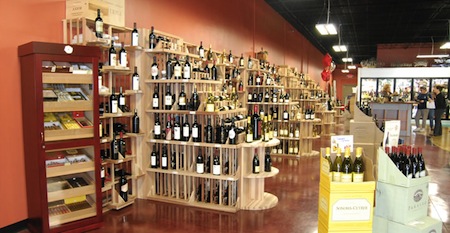
It's not just quantity that's better in Maryland, either. This is Long Meadow Liquors in Hagerstown. You can bet the Greencastle state store doesn't look like this.

So spacious! So well-organized! So friendly! So non-PLCB!
Fear not, Waynesboro! On January 2nd, it was announced that a new store would open...sometime.  No date given, no month even. Not that it matters to the PLCB; making citizens wait months, or even years for a store in their area is not uncommon at all. (Could be two years, like it was in Mountain Top.) Real businesses take less time to build stores than it takes the PLCB to lease and move into a current location. An ongoing PLCB FAIL. I mean, it isn't like they are a real business that has to take care of their customers or is worried about losing sales to the competition. They have no legal competition.

As you would suspect there are a number of grocery stores -- Giant, Foodland, Save-A-Lot, Martin's -- that would love to satisfy the wants of their customers by selling them wine and liquor, or at least wine. While they may not take the place of a full service liquor store, it would be far more convenient then relying on the one state store. Not every liquor store has to offer everything; not every grocery store does. Choice is always better for the consumer.

So there you have it. 2015 starting out like last year with more lipstick for the state store pig, and just like the 80 years prior, the citizens are left out again.

It's up to the Legislature and Governor Wolf to hear the needs of the citizens. Privatize and reap the benefits of the free market.

Thursday, October 23, 2014

Springfield and Philly. What a difference not having the PLCB makes!

Springfield Mo., "the queen city of the Ozarks." Population 167,000 with an MSA (Metropolitan Statistical Area) of a whopping 450,000. 
Philadelphia, "the city of brotherly love" (and those who buy their booze across borders). Population 1,526,000 with an MSA of 6 million.

Why am I comparing these two places? They both have a whiskey festival, although technically the one in PA is called the Whiskey and Fine Spirits Festival. "Fine Spirits" apparently includes things like Smirnoff Sorbet Light Peach and Ole Smoky Moonshine Hunch Punch, according to the masters of the mundane in Harrisburg.

So what do you get for your VIP dollars in PA? A chance to taste 304 spirits (really only 292, because some are listed twice!) of which about half (151) are something I would call whiskey or whisky. In Springfield you get  at least 200 whiskies and none are called Hunch Punch. You can look for yourself. Here is Philly, and here is Springfield. Not even close, which just shows the sad state that the PLCB is in. If a magazine can sponsor and put together a pretty good whiskey festival in a town the size of Springfield, but the 3rd largest retailer of spirits has to scrape the bottom of the barrel and still falls short, that speaks volumes about how well the PLCB serves the citizens, and what the industry thinks of our backwards system. Yes, I know the Philly Festival is sponsored by a magazine too but they can't do it without the expressed approval and participation of the PLCB.

Look at all the spirits PA doesn't carry. Must be 100 of them -- but they all are available in the free market. Of course, a number of things at the Philly Festival aren't available in PA either, which means if you really want some, you'll have to break the law to get it. All courtesy of the PLCB, who approved all of this. Even the highlights mentioned by the PLCB are laughable. There are only three, and two are for items you can't get. 

I especially like that Stranahan's Colorado Whiskey will be offered for tasting. It isn't carried at all by the PLCB, so the entire state is missing out on some pretty good whiskey. You can't get it if you did like it anyway. I guess they think the drive to State Line Liquors in MD is close enough. Which brings up the question: why even have this at the festival if the PLCB doesn't carry it? If you have no chance of buying some of the things they are offering, what's the point? It really does show how limiting and ignorant the people in Harrisburg are.

Face it, the PLCB is the reason why we can't even have a half-assed whiskey festival. People that do real festivals laugh at the PLCB and us the same way we laugh at somebody trying to buy a six pack at a distributor. You know that is the way it should be done, but somehow in PA it is never done right.

If you want to go to one of these things, plan a trip.  There are numerous festivals in the US, far better than the PLCB ones in Philly and Pittsburgh, plus you have a chance to actually buy the products you taste and give your money to somebody that cares about the consumer.  DC, New York, Boston Vegas, Nashville, LA, Bardstown, Atlanta, and more  As a consumer you deserve the best, so why support the worst?  The Free Market is the only real Modernization.

Monday, April 7, 2014

Privatization facts & figures


All the arguments against privatization — job losses, revenue losses, public safety endangered, less selection and higher prices, less convenience, and worse service — are addressed and refuted below, with facts and common sense. Arm yourselves with knowledge, and pass it on to your legislators.

Jobs - Everyplace in North America that has privatized some or all of their liquor distribution system has seen an increase in employment. Jobs in the industry tripled in Washington State and Alberta, Canada, the last two places that fully privatized. They doubled in Iowa, which kept wholesale sales but privatized all retail. Are the jobs exactly the same as what they replace? Probably not; are all jobs the same at every store where you shop now? Why would alcohol sales be any different?

Revenue and Border Bleed - Sales have gone up in privatized systems, every single one; how much is dependent on taxation more than anything else. Case in point is Washington State, which already had the highest liquor taxes in the country before they privatized and added new fees. Sales have still gone up in state, and the fee-driven increase in border bleed has increased sales out of state. If they hadn’t raised taxes, in-state sales would have increased even more. Washington State’s border bleed is nowhere near the border bleed rate in PA. The border bleed increase for an entire year in Washington is about a weeks worth of the border bleed PA sees.  While privatization will not eliminate border bleed in PA, it will, just from a convenience standpoint, decrease it. A privatized PA will still not be able to equal pricing of states with lower taxes, but it will make it easier to buy locally. People pay more for convenience all the time, even when less expensive alternatives exist reasonably close. Case in point is buying almost any food or dairy item in a convenience store — “a damn Sheetz,” as Senator Ferlo would snarl — instead of a grocery store. The key is to not raise taxes.

Revenue 2 – Iowa actually decreased their taxation and still reported making more than they would have if they kept their state stores.

Revenue 3 - It isn’t only direct liquor taxation that has to be taken into account. For PA, there will be business taxes that the current system doesn’t pay. There will be more income taxes from owners and workers, since there will be more of each. There will be new jobs created that do not exist under our current system, delivery to bars and restaurants being one example, and increases in current jobs to accommodate new business. Again, just one new warehouse in Washington State employed 1,100 workers, which was more than the entire state store workforce of 937. In the long term, money will be saved by not having taxpayers responsible for future retirement and medical shortfalls. The current amount the taxpayers owe for PLCB pensions is $550 million and is expected to go up to $600 million by the end of this year.

Safety
– Under the current system PA has more DUIs, DUI fatalities, underage DUI, binge drinking and underage binge drinking than 4 of the 5 privately run states on our border, and is just average compared to the rest of the country. Washington State has seen an 8% reduction in DUI crashes and DUI fatalities since privatization. While some may claim that is because there was less policing, policing has no effect on the decrease in DUI fatalities. Alberta, Canada has decreased their DUI fatality rate to one of the lowest on the continent (37% lower than PA) since they privatized, even though they have over 1,300 retail liquor outlets now for a population of under 4 million. Is there a connection? No way to say without further study, but it’s plain to see that privatization didn’t make the situation worse.

Safety 2
– Limiting underage access has always been a point for those opposed to privatization. While the true rate of underage purchases in PA State Stores is not known, since they are never independently checked (or policed in undercover sting operations, as privately-owned liquor stores in other states are) it would follow that it should be about the same as other localities which have similar requirements. Washington State was at approximately 93-94% compliance before privatization and is at about 92% now. Another thing we can learn from Washington State’s experience is how to limit direct unobstructed egress to cut down on shoplifting.

Selection
- Under the PLCB, urban areas essentially subsidize rural areas for alcohol selection, something that would seem to go against their stated mission of limiting access. This is the retail equivalent of PENNDOT making sure there is a Jaguar dealer in every county, because without government intervention they wouldn’t be there. Where the population can support them there will be larger stores, and in areas that can’t support those, there will be smaller stores. This is the retail model found almost everywhere. It is not the government’s job to make sure you can buy a wide selection of booze, especially when they say it’s detrimental (but they still want to sell you more of it). It is their job to make sure that a business climate exists which will allow retailers to try to sell whatever they want within the regulations and restrictions. To date I have not heard a reasonable explanation as to why the state should subsidize alcohol like they do milk.

Selection 2
- That in-store selection will increase is not in question. One only need to look across the country to stores like Bev-Mo, Total Wine, Roger Wilco, Binny’s, HighTime, B-21 and hundreds of others to see what the private sector can provide. They provide it based on consumer demand, not by what a bureaucrat or committee with unknown or non-existent credentials selects for them in a small capital city, far from major markets. What is in question is what variety will be available in rural areas. The answer is the same as it is for any other product. If the demand is there, the market will provide it, just as it does in rural grocery stores and hardware stores. If what you want is not available locally, chances are you will be able to order it, the same as now, only you probably won’t have to buy a case at a time as it is with a good portion of the current system. The entire state of big, small, specialty, urban, and rural stores will be open to you. Not that every store will ship but it will certainly be more than now, because real businesses strive for customer service since their existence depends on it and not state police enforced monopoly power.

Prices
– There are no absolutes in pricing. So much would depend on the system that is selected. Do we continue with the three tier system or do we eliminate one tier and allow more direct buying? Are taxes collected at the wholesale or retail level? Will the taxes increase or remain the same? Depending on what combination is used, you can say that prices should go down or prices should go up. The one thing you can say with certainty is that in a competitive market prices are lower than they would be given the same circumstances in a non-competitive market. As the third largest retail buyer on the continent one would expect the State Stores to have some of the best pricing available in the country. However, this is not always the case and the differences are more than taxes alone can account for.

Convenience – Since closing 20% of their stores in the past 40 years and having the lowest amount of stores per capita in the country (even lower than Utah!) there is no doubt the current system is inconvenient. Quite simply, anything that doesn’t open hundreds, if not a couple thousand more locations will not provide convenience seen in other states, and is a Band-Aid at best. It is obvious the PLCB cannot begin to compete in this area because they can’t afford it based on their business model of having everything the same store everywhere. Don’t let them buffalo you: the PLCB chooses the number of stores to open, not the legislature; the number of stores is not enforced by the Almighty Liquor Code (with the exception of the number of stores allowed to be open on Sunday). So while the population has increased over the last four decades, the number of State Stores has decreased from over 750 to about 605 today. Just to reach the national average, Pennsylvania should have about four times that number. “Modernization” does not begin to answer that issue, with one proposal saying they want to put 400 sq. ft. “stores” inside other stores, which they are already allowed to do now, and have been for at least 30 years. What exactly does that do for the consumer that the same size private store (which they claim wouldn’t provide the selection) would, besides remove that business opportunity from the citizenry?

Service – Unlike other retail stores, if you don’t like the service you can’t go anywhere else. You are stuck with the same training, the same attitudes, the same level of passion. In the world of private stores, if you don’t like the service you can go somewhere else and reward them with your business. The stores with bad service will eventually fail, and if somebody else sees the opportunity another will open. In the private sector you will find stores with a sales staff of well-trained professionals along with stores whose sales staff can barely tie their shoes. You have the choice of what level you require. Same size fits all is not a tenet of retail, although it seems to be gospel for the PLCB. There are private stores who have sommeliers on staff. The whole of the PLCB, 600 retail stores and an entire state’s wholesale wine trade, doesn’t. To be fair, the PLCB does have a sommelier as a part-time consultant. One. Part time. For the entire state. The third largest retail wine buyer on the continent does not have a full-time top tier wine person. I can’t be the only one to think there is something wrong with the system that not only allows this, but doesn’t care.

Privatization does create winners and losers.
The winners are the citizens who now have access to a free market; the losers are those who can’t adapt to the free market system. While no system is perfect, looking at the rest of the country it is easy to see which one is preferred by consumers and businesses whenever there is a choice.

TELL YOUR LEGISLATORS YOU WANT THAT CHOICE!

Wednesday, April 2, 2014

Let's Kill Another Privatization Myth II

Time to debunk another myth.

"Pennsylvania has such a high DUI fatality rate because we have so many rural roads...not because the PLCB doesn't control sales of alcohol very well."

While PA does rank 6th worst in total in the US for Rural Road fatalities (2009) we rank 16th worst in DUI fatalities (2011). For fatalities per 100 million rural road miles driven PA isn't in the top ten or even top twenty but is number 23 (2009).


I had this page full of numbers and charts and math to prove the point but it comes down to this: 
Of the six border states and PA itself, PA is 5th worse in rural road death rate per 100 million miles traveled. It also turns out that PA is 5th worse in DUI fatalities.  In fact the rural road death rate and the DUI fatality rate coincide with each other for all seven states.  New Jersey has the lowest rural road and DUI fatality rate and West Virginia has the highest.  Common sense shows that the rural road fatality rate is a causation of DUI rate and not the other way around. Maybe the next excuse by the clerks will be to blame PennDot because we have too many potholes...anything but the lack of control by the PLCB


STATE Rural Road


Death Rate

New Jersey 1.48

Maryland 1.89

New York 1.95

Ohio  2.2

Pennsylvania 2.23

Delaware  2.41

West Virginia 2.62


(rates based on per 100 million miles traveled)

Looking at DUI fatality rates per 100,000 population we have

New Jersey - 1.7
New York - 1.9
Maryland - 2.7
Ohio - 3.0
Pennsylvania - 3.4
Delaware - 4.0
West Virginia - 4.7

I do want you to notice that the 4 states with better than PA's DUI rates all have private liquor sales and the one other control state (WV) has a worse DUI rate.

You could say that having the PLCB is killing more Pennsylvanians than would happen without it..

Monday, December 16, 2013

Why can't Johnny read or do math?


For those of us following such things there has been a trend by some union representatives and clerks to spin or play down the amount of drinkers and thus making our voice seem more like a minority and not as important as those who think they are keeping utter chaos and ruination at bay. 

Specifically, they like to use the 13% number as those who drink once a week. However, as with most things math the clerks and the union have their own way of doing things.  What they seem to fail to realize is that the total is cumulative – i.e. you have to add the everyday, the few times a week and the about once a week numbers to see the TOTAL amount of people who drink at least once a week. This number ranges from 30 to 35% depending what time period you look at.   

In fact, Gallup has shown time and time again that 66% of the entire adult population drink some amount of alcohol.  As they reported in August this year “Thirty-five percent report having had a drink in the last 24 hours and another 29% in the past week.” This works out to 64% of drinkers which are about 66% of the population which comes out to over 42% of the total population (.64*.66 = .4224).  This is higher than what is normally reported because of the holiday included in the survey period which means some special occasion drinkers are added in that normally wouldn’t be.

We 2/3rds of Americans who choose to drink are the majority that the state store system wants to control.  They tell us what, they tell us when and they tell us where – the very antitheses of the freedom an open market brings to the citizens.  Taxation, regulation and enforcement are the role of government, not retail sales. The citizens and the state will be far better off once the aberration of the current state store system is corrected. Every state or province that has privatized some or all of their alcohol system has seen an increase in employment in the industry.  It tripled in Washington and Alberta. Increased in Ohio, Iowa, Maine and West Virginia too.

We are not inventing the wheel again.  Take the best of that the majority of the states do, regulate and enforce what they have problems with and come up with the best system.  That is real modernization not putting lipstick on the state store pig with new names or wicker baskets.

Privatization IS Modernization – Accept nothing less.


Provided for historical data (Gallup)

Every
day
A few
times
a week
About
once a
week
Less
than
once
a week
Only on
special
occasions
Never
No
opinion

%
%
%
%
%
%
%
2007 Nov 11-14
7
13
10
9
29
33
*
2006 Nov 9-12
10
13
11
9
27
30
*
2005 Nov 7-10
5
14
11
10
29
31
*
2004 Nov 7-10
7
13
13
10
25
32
*
2003 Nov 3-5
7
16
13
12
25
27
*
2001 Nov 8-11
7
12
13
14
24
30
*
* Less than 0.5%